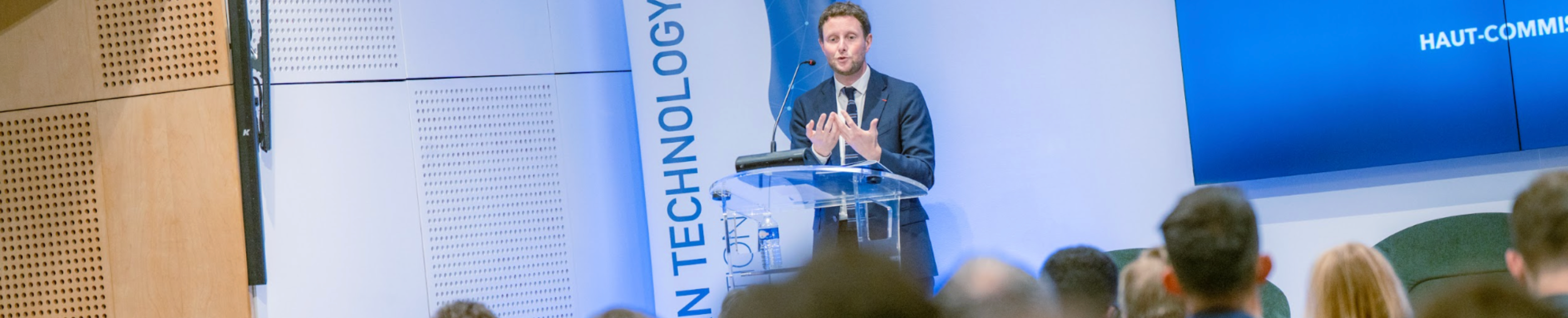
Official Presentation of the Report to Clément Beaune
On May 19, 2026, the Human Technology Foundation presented its report, “Managing Dependencies: The Real Lever of Digital Sovereignty”, during an event held at the Caisse des Dépôts, marking its official submission to Clément Beaune, High Commissioner for Strategy and Planning.
The event brought together business leaders, digital experts, institutional representatives, and economic stakeholders to address a question that has become increasingly critical: how can organizations continue to act effectively in an environment shaped by ever-growing technological dependencies?
In his opening remarks, Eric Salobir, President of the Human Technology Foundation, outlined the report’s core ambition: to provide a practical approach to digital sovereignty, not as a pursuit of complete independence, but as an organization’s ability to identify its dependencies, prioritize them, and make informed trade-offs between risk, cost, and performance.
Drawing on fictional scenarios, clear definitions, and a “slider-based” framework designed to make visible the tensions between sometimes competing objectives, the report offers an operational methodology to support organizational decision-making. No single position can be considered inherently optimal; every strategic choice results from balancing multiple factors, according to the specific constraints, risks, and priorities of each organization. In this way, the report seeks to bring clarity to a topic that remains challenging for many executives to navigate.

The first session of the evening featured a panel discussion entitled “Digital Sovereignty: Managing Dependencies Rather Than Enduring Them,” moderated by Joséphine Staron and bringing together Olivier Vallet, Chairman and Chief Executive Officer of Docaposte; Catherine Mayenobe, Deputy Chief Executive Officer of Caisse des Dépôts; Mehdi Houas, Founder and Chairman of Talan; and Damien Lucas, Chief Executive Officer of Scaleway.
The discussion focused on some of the most underestimated risks facing organizations today, including vendor lock-in, legal exposure, infrastructure reversibility, and cloud market concentration. Participants emphasized that digital sovereignty can no longer be viewed solely as a technological issue. Beyond infrastructure and tools, it is fundamentally a matter of trust and of an organization’s ability to retain control over its strategic choices.
The panel also explored the prospects for developing credible European alternatives. Speakers discussed the challenges Europe still faces in fostering players capable of competing at scale, particularly in the cloud sector, as well as the reluctance of many organizations to change their technological habits even when alternatives are available.
The situation of SMEs and mid-sized companies also featured prominently in the discussion. Participants highlighted that decisions relating to digital resilience become significantly more complex when financial, technical, or human resources are limited. As a result, a gap remains between large corporations and smaller organizations in their ability to maintain control over their technological choices.

The evening continued with an operational session dedicated to decision-support tools and the management of digital resilience. Moderated by Joséphine Staron, this discussion brought together Catherine Mayenobe, Arno Pons, President of aDRI, and Eric Salobir.
Speakers emphasized the need to translate digital resilience into clear and actionable criteria for decision-makers. The discussion also addressed the creation of the Digital Resilience Index (DRI) and explored how digital sovereignty can become a genuine strategic management tool for organizations.
Through this report, the Human Technology Foundation advocates a straightforward principle: in an environment defined by interdependence, dependency is inevitable, but it must not become uncontrolled. The objective is therefore not to eliminate all dependencies, but rather to make trade-offs explicit, enabling organizations to make informed decisions with full awareness of the associated risks and opportunities.